

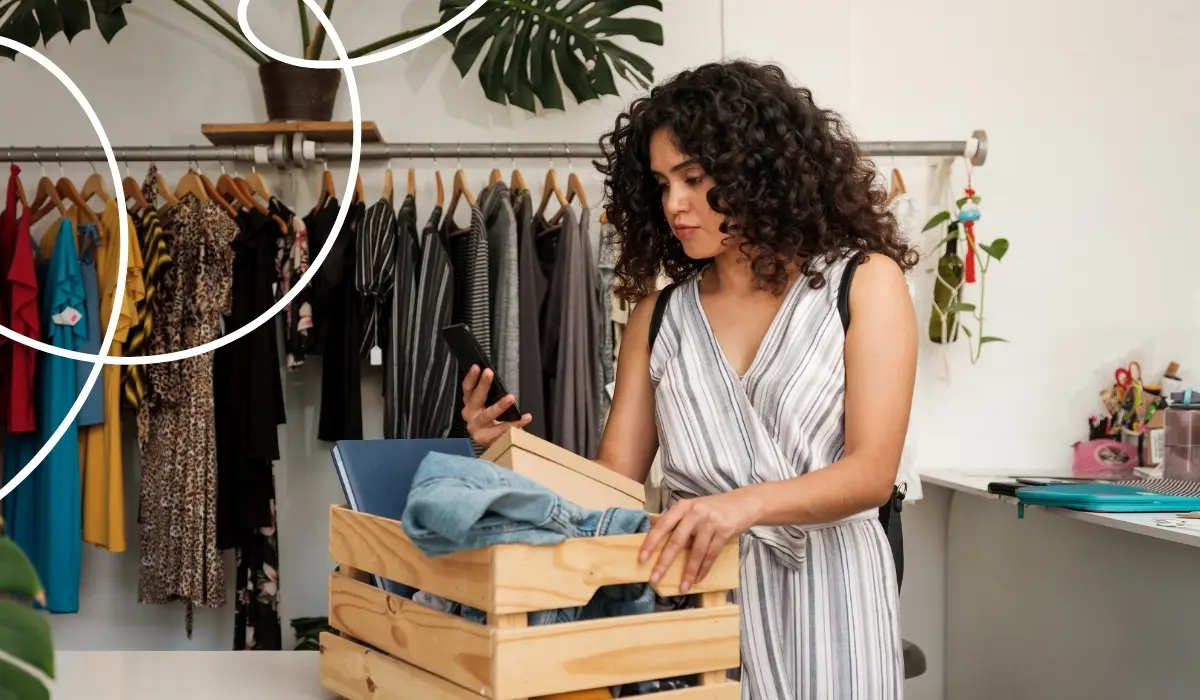
Was the jacket too small, didn't the customer like the gift, or do the shoes not fit right? There are many reasons why customers return purchased items to your store. At first glance, returns seem like a loss: You need resources to process them, and the customer was clearly not satisfied.
Nevertheless, returns offer a tremendous opportunity for customer retention, because the customer comes back to you and has another point of contact with your business. And you should definitely take advantage of this. Those who handle returns well and provide excellent service often earn more loyalty than through the purchase itself. On the other hand, this moment is also particularly critical: If you organize the returns process poorly, you’re very likely to lose your customers for good.
In this article, we’ll show you how to use returns processes to their fullest potential to build customer loyalty.
What do returns have to do with customer loyalty?
Is returns management purely a logistics issue?
In many companies, the issue of returns is handled in the warehouse, where items are inspected, recorded, and refunded. While this is true, it is still too narrow a view. Because while a box is being opened in the warehouse, someone is waiting for a response.
That’s why returns management encompasses all processes related to a return: reporting the return, shipping, receiving the goods, inspection, refund or exchange, and communication between all these stages. It is precisely this last point that determines your customers’ satisfaction and loyalty. Everything that comes before it only affects your costs.
Conceptually, this topic is therefore more closely related to customer service than to logistics, and it resembles complaint management more than many people realize. But one major difference remains: With a complaint, something has gone wrong or the customers are dissatisfied; with a return, however, this is often not the case.
The Most Common Reasons for Returns
Before you adjust the quota, you need an accurate breakdown. While some returns are certainly your fault, others are simply part of doing business and can't be avoided.
For this reason, be sure to record the reason for the return for every return, preferably using a short drop-down list in the returns portal. You should avoid free-text fields, as they are rarely filled out and are more difficult to analyze.
| Reason for Return | Who causes it | What it says about your business | First Countermeasure |
|---|---|---|---|
| The size doesn't fit | usually you | Your size information and fit guidelines are too vague | Size charts for each item, notes such as „runs small,“ and allow fit reviews |
| The item does not match the description | you | Images, color accuracy, or material specifications are incorrect | Real product photos instead of manufacturer images, close-ups, check the material specifications |
| Quality Falls Short | you | Expectations and the product don't match | Review the product lineup, write a more honest description, and meet with suppliers |
| Selection order—that is, intentionally ordering multiple sizes | the clientele | Our size guide does not yet replace trying on clothes | Offer pre-purchase advice, provide a size guide, promote in-store try-ons |
| Delivered too late | you | There is a gap between the promised and actual delivery times | Provide realistic delivery times; actively report delays |
| Arrived defective | you | There is a weak point in the packaging or order-picking process | Packaging standards by product category; photo verification in cases of bulk orders |
| Change of Opinion | the clientele | Nothing—that's just part of distance selling | Don't fight it—handle it properly and offer alternatives |
| The gift didn't arrive or wasn't the right fit | shared | Buying gifts requires its own set of rules | Extended Deadline During the Holiday Season; Gift Credit Instead of a Refund |
If you want to lower your return rate, you should first check whether you can influence it at all and what steps you can take to improve the customer experience. After all, when it comes to reasons for returns such as ordering multiple items to choose from or simply changing your mind, there’s little you can do without straining your relationship with your customers.
How can I reduce my return rate?
The return rate can usually be reduced quite easily: You can introduce return fees, shorten the return window, and make the return form more complicated. The number in the report may look better as a result. However, customers often don’t come back. A low return rate is therefore only a good sign if it’s based on better product information.
Measures to Improve Customer Loyalty:
To maintain customer loyalty and ensure a positive customer experience, you should start by optimizing the shopping experience. In other words, instead of making returns difficult, you should provide your customers with as much information as possible to help prevent them.
| Action | Effect on the rate | Effect on Binding |
|---|---|---|
| Exact size specifications by item, not by brand | significantly lower for clothing and shoes | positive, because the counseling is seen as helpful |
| Actual product photos and close-ups | Deduction for the reason „does not match the description“ | positive, because the forecast is more accurate |
| Allow reviews with fit recommendations | reducing, because other customers are also consulted | Positive reviews also boost trust |
| Pre-purchase advice via message or in-store | reducing, especially for high-priced items | Very positive; the personalized advice really sticks with you |
| Accurate information regarding materials, weight, and dimensions | reducing costs for housing and sports | Positive—honesty benefits the brand |
Additional measures:
Stricter measures, such as shortening the return period or passing on return costs to customers, may lower the return rate, but they’ll cause your customers to shop elsewhere next time to minimize the risk. Especially when it comes to reasons for returns such as ill-fitting clothing sizes, such measures come across to customers as a punishment for something that isn’t their fault. In the long run, this leads to dissatisfaction and customer churn.
| Action | Effect on the rate | Effect on Binding |
|---|---|---|
| Pass on return shipping costs to customers | decreasing, often significantly | Negative—the next purchase will be made elsewhere |
| Reduce the return period to the statutory minimum | slightly downward | negative; comes across as petty and is reviewed before purchase |
| Cumbersome form or returns only upon request | decreasing | negative; the effort just ends up being a hassle |
| Refund Not Processed Until Weeks After Receipt of Goods | barely decreasing | very negative—a common reason for customers to leave after returning an item |
| Returns can only be made online, not in-store | slightly downward | That's a mistake—you're giving away your most valuable point of contact. |
Last but not least, it’s extremely important to also consider the average return rates in your industry. These can vary widely depending on your product range, price point, and customer base. Therefore, you should never compare yourself to stores in other industries or those selling completely different products. The most reliable approach is to measure yourself solely against your own rate over time.
The Return Process, Step by Step
Now it’s time to put this into practice. Every step has two sides: on the one hand, what’s happening behind the scenes for you, and on the other, what your customers are feeling at that moment. Many businesses focus solely on planning the process itself. However, true customer loyalty only develops when the emotional connection is right.
The following seven steps will walk you through the entire process. The sample text provided here is just a template. Simply adapt it to match the way you speak with your clients.
| Station | What the person is feeling right now | What You Can Do | Sample Message |
|---|---|---|---|
| The item arrives but doesn't fit | Disappointment, mild annoyance at the wasted time | Return instructions are included or listed on the packing slip, in a single sentence and without any fine print | „Doesn't fit? No problem. Return it in just two clicks using the link in your order confirmation.“ |
| Request a Return | Uncertainty about whether this is going to get complicated | Returns portal with basic selection, generate labels immediately, offer exchanges directly | „Your return has been processed. You'll find the shipping label attached. Would you prefer a different size? We'll exchange it right away.“ |
| Drop off a package | Relief, but also the feeling of taking the first step | Multiple drop-off locations, allow returns at the store, use a QR code instead of a printer | „Thanks—your package is on its way to us. We'll let you know as soon as it arrives.“ |
| Your order will arrive | Waiting and uncertainty—that's where most mistrust arises | Confirm receipt on the same day, even if the review is still in progress | „We have received your return. The review usually takes one to two business days.“ |
| Review and Decision | Make sure something is complained about | Be accommodating when reviewing, ask questions politely, and avoid standard phrases | „Everything's fine with your return. The refund has been processed.“ |
| Refund or Exchange | Rating: Was that fair and fast? | Initiate the refund immediately after the review and clearly specify the date | „We've refunded you €79.90. Depending on your bank, your account will be back in the black in one to three business days.“ |
| Follow-up | Openness—the anger is gone, but the need is often still there | After five to ten days, suggest a suitable alternative; do not offer a flat-rate discount | „The jacket was too small. The same style is back in size M—would you like to try it on?“ |
In addition, one detail is often completely underestimated: the waiting time between returning an item and receiving a refund. Many companies tend to remain silent on this point—and customers quickly get the unpleasant feeling that they’re being strung along.
Yet the solution is extremely simple: A brief, automatic confirmation of receipt won't cost you a cent, but it immediately takes all the pressure off the situation.
Exchange Instead of a Refund
With a refund, the money is gone; with an exchange, the sales revenue stays with you. It sounds completely logical, but in practice, it’s surprisingly rarely used strategically. In fact, many returns portals either lack the exchange option entirely or hide it well behind the refund button.
Let's quickly work through this difference. The following numbers are just examples to illustrate the principle. Later, just plug in your own numbers.
| Position | Before (Assumption) | Afterward (Assumption) |
|---|---|---|
| Returns per Month | 400 | 400 |
| Average value of goods per return | 70 € | 70 € |
| Total value of returns per month | 28.000 € | 28.000 € |
| Exchange rate | 15 % | 30 % |
| Returns That Become Exchanges | 60 | 120 |
| Revenue that stays within the company | 4.200 € | 8.400 € |
| Additional stay per month | – | 4.200 € |
| Projected over twelve months | – | 50.400 € |
Let’s break it down: If you have 400 returns and a 30 percent exchange rate, that’s 120 sales retained. With an average item value of €70, you’ll save €8,400 in revenue. If you previously managed only 60 exchanges during the same period, you’ll now have a whopping €4,200 more in your coffers.
The only factor you still need to subtract individually in this model calculation for your own product line is the additional shipping costs for the new route to the customer.
Four Strategies for a Higher Conversion Rate
- Exchange sizes directly on the portal: When you request a return, you'll see right away if the item is available in a different size. One click, and you're done.
- Credit with a small bonus: If you choose the credit option, you'll get a little more than you would with a refund. The bonus can be small—it just has to be visible.
- Suggest alternatives instead of empty confirmation: In the exchange step, show two to three suitable items from the same category and price range.
- Advice via message: For high-priced items, it’s worth sending a quick personal message. „What size do you usually wear?“ goes a long way—much more than any automated response.
The Store as a Return Channel
Pure e-commerce guides almost always overlook one crucial point—one that’s pure gold for you, especially in local retail: When someone returns their online order directly to your store, that person is suddenly standing right in front of you.
While returns are merely a costly nuisance for purely online stores, they are a real blessing for your brick-and-mortar store. The customer has made the trip, is standing right in the middle of your product selection, and clearly has an unmet need. That’s the absolute best foot traffic you can possibly get for your store space.
However, the outcome of this interaction depends entirely on your team’s first three interactions at the register. Since no one likes the uncomfortable feeling of being immediately and clumsily pressured into buying the next item when returning a purchase, this is where your tact and sensitivity as a local advisor are put to the test.
That’s exactly why, for the in-person conversation on site , this order always applies: First, handle the matter thoroughly; then make the offer. We also demonstrate just how much of an experience the store can be in our article on customer loyalty in retail.
| Situation at the checkout | Appropriate sentence | Why It Works |
|---|---|---|
| The person hands it over without saying a word | „Thank you. May I ask briefly what wasn't right?“ | You'll get the reason for the return straight from the customer, without pressing them |
| Size was the problem | „We have these here in two other sizes. Would you like to try them on?“ | The return becomes an exchange—right away |
| I didn't like the article | „I see. We have something similar here in a different style.“ | No pressure, just an offer—the person decides for themselves |
| The refund will take | „It will take one to three business days to arrive in your mailbox. I'll send you the confirmation.“ | Giving a specific time frame alleviates the most common concern |
| This person is not yet in the program | „With our app, you can check the status yourself at any time. It takes just two minutes to sign up.“ | The benefit becomes immediately apparent the moment you return it |
| The person is visibly upset | „That annoys me, too. I'll take care of it for you right now.“ | Not justification, but acceptance—that’s the most reliable way to defuse the situation |
Your Loyalty Program as a Return Lifesaver
A loyalty program won't automatically improve your returns process, but it does provide you with a direct channel that's already open. After all, anyone who has your app on their smartphone doesn't have to search through customer service emails or go through the hassle of logging into a returns portal.
To ensure this goes smoothly in practice, you should strategically use these three points:
- Communicating About Points: It makes sense to deduct the points you've earned when processing a return. However, if this happens without any explanation, it can quickly feel like a punishment to the customer. A brief, explanatory sentence is enough to prevent this frustration.
- The Exchange Bonus: Customers who exchange their items instead of requesting a refund get to keep their points or even receive a small extra bonus. This is a smart incentive that rewards customers and keeps business in-store.
- The push notification: With direct in-app messages, you can easily reach the very people who have long since stopped paying attention to your traditional email newsletters.
Learning from Returns: Personalization and Speed
Consider the reason for the return as valuable information for future recommendations. If someone indicates „runs small“ three times in a row for tops, they should logically be shown a size larger right away in the next purchase suggestion. In our article on Connecting Your Online Store, CRM, and Loyalty Program, we’ll show you how to seamlessly integrate these systems.
The fact that customers expect exactly this kind of proactive thinking is confirmed by the latest DACH Loyalty Report 2026: 62 % of respondents in Germany and 55 % in Austria simply expect personalized offers. And they show no mercy when it comes to speed either: 80 % (DE) and 87 % (AT) demand rewards that can be redeemed immediately.
Applied to your returns process, this means one clear rule: A credit that your system doesn't release until after four weeks of processing time doesn't help anyone.
The Special Case: Frequent Returners
You’ll find them in almost every store: that small but persistent group of customers who seem to return more products than they keep. While the temptation is naturally strong to „frequent returners“ judge them emotionally or get annoyed by them, that won’t get you anywhere in business. Instead, it’s much more worthwhile to take a look at the actual numbers.
In the end, the only thing that really matters is the true net customer value. The formula is simple: gross revenue minus the value of returns minus processing costs.
To make this more concrete, in the following example we’ll use €8 in processing costs per return. This is a placeholder amount chosen at random to cover shipping, quality control, and restocking. Since this amount can vary greatly depending on the industry and product line, it’s essential that you determine your own specific figure for practical purposes.
| Customer Type | Ordering Behavior Over the Course of the Year (Assumption) | Net Customer Value (Invoice) | Recommendation |
|---|---|---|---|
| Frequent buyer with a high conversion rate | 12 orders at €120 each, return rate of 60 %, 9 returns | 1,440 € − 864 € − 72 € = 504 € | Keep and court. Despite the high percentage, this is the most valuable type in this overview |
| Occasional buyers with a low purchase rate | 3 orders of €90 each, return rate 10 %, 1 return | 270 € − 27 € − 8 € = 235 € | Unassuming and reliable. In this case, it's better to have a higher purchase frequency than to deal with returns. |
| Constant Taster | 8 orders at €60 each, return rate 85 %, 7 returns | 480 € − 408 € − 56 € = 16 € | Offer pre-purchase advice, actively promote the size guide, and monitor progress |
| Boundary case near zero | 2 orders of €200 each, return rate 95 %, 2 returns | 400 € − 380 € − 16 € = 4 € | Talk to them personally and ask why before applying any rules |
Why the raw return rate is often misleading
In practice, the result of this calculation surprises many: In fact, a loyal customer with a return rate of 60 percent often generates significantly more profit overall than the model occasional buyer. That’s why a return rate, taken in isolation, is by no means a criterion for exclusion. Only when the net customer value—after deducting all process costs—consistently trends toward zero is it time for a clarifying discussion.
But here, too, the same principle applies: This interaction must never come across as a lecture. Instead, you should show genuine interest in the underlying cause. Ask about the specific reasons for the high number of returns, offer personalized advice, or suggest ordering in smaller, more targeted quantities in the future rather than in large batches. Only if, despite your active support over the course of several months, there is absolutely no change in this pattern, are stricter rules for this specific case a commercially legitimate step.
Key Metrics in Returns Management
Let's not kid ourselves: Without hard numbers, the whole topic remains purely a matter of emotion. To help you make decisions based on facts rather than gut feelings in the future, the following overview brings together exactly the key metrics that are truly meaningful for your business.
Since a buzzword like KPI (Key Performance Indicator) isn’t much use to you in everyday life, we won’t stop at theory: For each value, you’ll get the corresponding, straightforward calculation method right away. This way, you can immediately verify the numbers for your business yourself.
| Key figure | Formula | What she shows you |
|---|---|---|
| Return rate (per item) | Returned items ÷ Shipped items × 100 | How much merchandise is physically returned—relevant for warehousing and logistics |
| Return Rate (by Value) | Value of returned merchandise ÷ Value of shipments × 100 | How much revenue is actually affected—relevant for the calculation |
| Exchange rate | Returns with exchanges ÷ total returns × 100 | How effectively you convert returns into sales |
| Processing time until reimbursement | Total number of days from receipt of goods to refund ÷ number of returns | The single most powerful factor influencing customer satisfaction when a service issue arises |
| Repurchase Rate After a Return | Customers who returned an item and then made another purchase ÷ total number of customers who returned an item × 100 | Whether Your Return Process Builds Loyalty or Drives Customers Away |
| Net Customer Value | Gross Revenue − Value of Returns − Processing Costs | What a person actually contributes over a period of time |
Measure both metrics over the same time period; otherwise, the comparison will be skewed. A 90-day window following each event has proven effective in practice. You can find more metrics related to customer retention in our overview on Measuring Customer Retention.
The Building Blocks of a Binding Returns Process
If you're approaching this topic from scratch, these are the six parts that need to fit together. None of them works particularly well on its own.
1. Returns Portal with Basic Data Entry
You can request a return in just two or three clicks, and the label is generated immediately. A short drop-down menu lets you select the reason for the return without being a hassle.
2. Exchanges First
Size exchanges come before refunds, not after. Available alternatives are displayed immediately, along with stock levels.
3. News in Four Points
Registration confirmed, package on its way, item received, refund initiated. Four short messages bridge the gap where mistrust would otherwise arise.
4. Returns at the Store
Online orders can be returned in-store. The team has prepared phrases to turn the return into a consultation.
5. Program is properly integrated
Points are credited back correctly and transparently. Anyone who exchanges points instead of returning them retains their benefit.
6. Key Metrics at a Glance
The return rate, exchange rate, processing time, and repurchase rate following a return are all summarized in a monthly report.
Common Mistakes in Returns Management
The following mistakes crop up time and again in practice and often unnecessarily derail even well-managed returns processes. The really frustrating thing, however, is that none of these stumbling blocks is actually that difficult to fix—provided you catch them early enough.
| Error | The damage he causes | That's better |
|---|---|---|
| Silence Between Goods Receipt and Refund | The person feels like they're being strung along and asks the service staff about it—which costs you even more time | Automatically confirm receipt on the same day, with a realistic estimated time frame |
| Deduct points without comment | It seems like a punishment for a legitimate return | Explain the chargeback in one sentence, directly in the message |
| Do not offer exchanges at all | Sales are slipping away, even though the need is still there | Prioritize the exchange over the refund on the portal |
| Do not enter a reason for the return | You're fixing things blindly and repeating the same mistakes | Shortlist on the portal; review monthly |
| Treat Returns as a Matter of Debt | Defensive language creates resistance where none is needed | Handle the matter objectively and treat the return as a routine procedure |
| Do not allow returns at the store | You lose the most valuable point of contact, and you're still responsible for shipping costs | Accept online orders in-store by connecting the register to the online store |
Conclusion: Turn returns into your best way to attract customers
Let’s be honest: A return will never be your favorite part of the workday. But this is exactly where the wheat is separated from the chaff: Those who dismiss returns as nothing more than a logistical nuisance and artificially complicate the process may boost their metrics in the short term, but they’re very likely to lose their customers for good.
This smart alternative turns what might seem like a loss into an unbeatable tool for customer retention:
- If you position the exchange option strategically on the portal and make it more appealing than a simple refund, you'll keep the revenue in-house.
- If you communicate proactively during the critical waiting period between receipt of goods and reimbursement, you can alleviate frustration and build a great deal of trust.
- And if you also accept returns from the online store directly at your store, you’ll turn a routine transaction into the most valuable and personal opportunity to provide advice in your entire store.
At the end of the day, what really matters for your business is the true net customer value and the repurchase rate after a return. So don’t view the next return box on your counter as lost revenue. See it as a communication channel that’s already been paid for—and as your most effective opportunity to turn an uncertain occasional buyer into a genuine, loyal regular customer.