


Many businesses start their digital customer loyalty program with a wallet card in Apple Wallet or Google Wallet. It’s quick to set up and easy for customers to use. But at some point, the question arises: Is that still enough, or is it time for a dedicated app?
That's exactly the question we'll answer in this article. We'll show you where the wallet card has its limitations, what an app can do that it can't, and when it's really worth making the switch.
What is the difference between a wallet card and an app?
Before we compare them, it’s worth taking a look at these two terms. After all, they sound similar but work very differently.
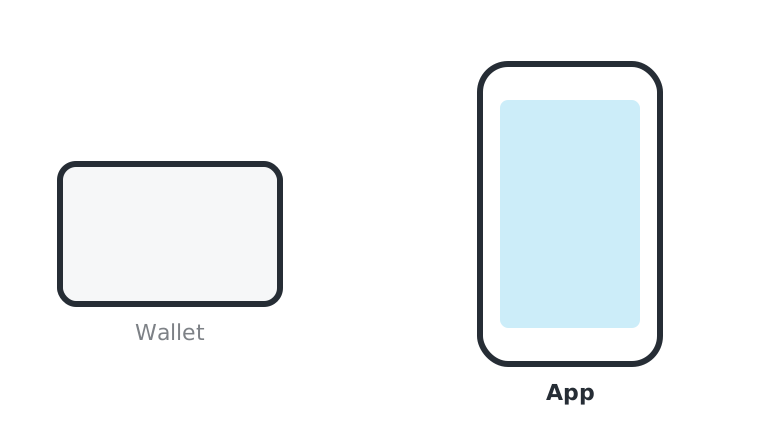
A Wallet card is a digital loyalty card stored directly in Apple Wallet or Google Wallet—that is, in your smartphone’s digital wallet, alongside boarding passes and tickets. Customers can save the card with a single tap, without having to download an app or register.
A Loyalty App, on the other hand, is a standalone application that customers download from the App Store or Google Play. It runs independently of the wallet and offers its own user experience—from earning points to redeeming coupons.
The Wallet Card: A Quick Start with Clear Limits
The big advantage of the wallet card is how easy it is to get started. Customers don't need a password or a new app on their phone. This significantly lowers the barrier to making that first digital interaction.
Push notifications can also be sent directly to the lock screen, for example, when a new stamp is earned or a reward is received. A dashboard also allows you to track membership numbers and card activations.
The limitations become apparent as soon as you want more: personalized campaigns, complex customer journeys, or deep CRM integration (i.e., the systematic management of your customer relationships in a customer relationship management system) are virtually impossible to implement with a Wallet card. And on iPhones, push notifications from Wallet have only worked since iOS 16.4—and even then, only to a limited extent.
The App: More Control, More Engagement, More Revenue
Your own app—whether as a white-label solution (an existing, customizable platform with your design) or a custom-built solution—gives you significantly more tools at your disposal. Push notifications work reliably on all devices, regardless of the operating system.
On top of that, there are sophisticated CRM features: You can segment your customer base, roll out targeted offers, and set up tiered programs or gamification elements. All of this runs in a single system that you manage centrally.
The trade-off is a higher barrier to entry: customers have to download the app from the store. But this is exactly where we see that the willingness is there. According to the DACH Loyalty Report 2026, 73.8 % of users who still use a physical card would switch to a digital solution immediately.
Wallet vs. App: A Head-to-Head Comparison
The key differences at a glance:
| Criterion | Wallet Card | App (white-label or in-house development) |
|---|---|---|
| Barrier to entry | Very small; no download required | You must download the app from the store |
| Push Notifications | Limited, primarily to iOS | Reliable on all devices |
| Personalization | Hardly possible | Comprehensive and customizable |
| CRM & Analytics | Basic Reports in the Dashboard | In-Depth Customer Data and Segmentation |
| Customer Journeys & Gamification | Cannot be displayed | Tiered programs, points, personalized journeys |
| Costs | Very low | Predictable, depending on the provider |
| Development Effort | Minimal | Low for white-label solutions, high for in-house development |
When is it worth switching from a wallet to an app?
There is no specific date when the switch will become mandatory. But there are clear signs that this will happen.
| Signal in Your Business | Recommendation |
|---|---|
| You're still just getting started with customer retention | The Wallet card is more than enough to get started |
| Your base of regular customers is growing noticeably | Switching to an app is worth it to strengthen customer loyalty |
| You want to run targeted, personalized campaigns | This can only be truly implemented with an app |
| Many of your customers use iPhones | An app ensures more reliable push notifications |
| Are you planning tiered programs or gamification? | An app is required; the Wallet card has its limitations here |
| You need in-depth customer data for marketing | The app provides the necessary depth of CRM functionality |
How to Make the Switch in 5 Steps
- Back up your data: Export member data and card balances from your wallet solution before you begin.
- Choose the right solution: A white-label app usually gets you up and running faster than a custom-built solution.
- Informing customers: Communicate the change early on, preferably directly through the wallet card itself.
- Plan for a transition period: Run the Wallet card and the app in parallel for a while so that no one gets left behind.
- Evaluate results: After the transition, check how many customers are actively using the app, and make adjustments as needed.
Common Mistakes When Switching from a Wallet to an App
- The switch is coming too late: Anyone who waits until the wallet solution has long since reached its limits is squandering potential.
- Existing customers are not being informed: Without clear communication, the new app remains empty.
- Too many features at once: Start with the most important features and expand step by step.
- No incentive to download the app: A small welcome bonus noticeably increases the conversion rate.
Bottom line: It's worth making the switch as soon as you want to grow.
The Wallet card is a great starting point for your digital customer loyalty program. It lowers the barrier to entry and provides initial push notifications and analytics.
But if you really want to turn walk-in customers into regulars, there’s hardly any way around having your own app. Personalization, reliable push notifications, and in-depth CRM data are only available there.
FAQ: Frequently Asked Questions About Wallets vs. Apps
What is the difference between a wallet card and a loyalty app?
A wallet card is stored in Apple Wallet or Google Wallet and doesn't require downloading an app. A loyalty app is a standalone application with significantly more features, such as personalization, gamification, and in-depth customer analytics. The Wallet card is particularly well-suited as a simple starting point, while the app is designed for building long-term customer loyalty.
Can I transfer customer data from the Wallet card to an app?
Yes, that's usually possible. It's important to properly export the member data and card balances before the switch and transfer them to the new app. A good provider will assist you with this migration to ensure that no data is lost.
Is an app always a better choice than a wallet card?
Not necessarily. For businesses just starting out with customer loyalty programs, a wallet card is often more than enough. But as soon as you want to grow, personalize your program, or incorporate gamification elements, the wallet card reaches its limits. That’s when the app becomes the clearly better choice.
How long does it take to switch from the wallet to the app?
That depends on the solution you choose. With a white-label app—that is, an existing, customizable platform—you can often go live within a few weeks. Developing your own solution, on the other hand, takes significantly longer, usually several months to over a year.
Do push notifications work just as well in the Wallet as they do in an app?
Not quite. Push notifications from the Wallet app are primarily limited to iPhones and have only been possible since iOS 16.4. An app, on the other hand, reliably sends push notifications on all devices and operating systems.
Do I have to offer both the Wallet card and the app at the same time?
A transition period during which both formats are used in parallel usually makes sense. That way, you won't lose customers who are already using the wallet card, while new and active customers gradually switch to the app.