

Unfortunately, many companies don’t place a high priority on customer loyalty. In practice, however, it’s one of the most reliable drivers of predictable growth—especially when you view it as a comprehensive system rather than just launching isolated campaigns for your customers.
In this guide, you'll get a clear A 7-Step Plan for Implementing Your Own Customer Loyalty Strategy: From identifying and engaging your target audience to designing your own loyalty program and launching it.
What exactly is a customer retention strategy?
Simply put: A customer retention strategy is a plan that outlines how you’ll take care of your customers after their first purchase so they’ll come back.
This involves four steps: You start by Goals positive (for example, more repeat purchases), you share your Customers in groups or segments such as New, Active, At risk and VIP enter, select a suitable one Mechanics (such as points or status) and ultimately evaluates based on a few KPIs, whether your strategy is working.
What it is not:
- „10 % discount this week“ is a one-time promotion, but not a strategy.
- „We're posting more often now“ is communication without a system and rarely yields predictable results.
- „We need an app“ is a channel, but on its own, it’s not a strategy.
Step 1: Set Goals & Boundaries
Before you build anything, you need to figure out the direction: What needs to be improved, and what are the limitations?
- Repurchase increase (frequency, retention)
- Shopping Cart increase (packages, upgrades)
- Recommendations increase (NPS)
- Out-migration reduce (win back customers)
And set limits so that it all adds up:
- Margin: How much profit can you actually make per customer?
- Effort: What can your team really handle on a day-to-day basis?
- Data: What do you already know, and what will you learn through the program?
Step 2: Segment the Target Audience
Segmentation sounds more complicated than it needs to be. The main point is to avoid sending the same message to all customers and to reach them in the most personalized way possible:
- New: First purchase; trust has not yet been established
- Active: buys regularly, open to additional offers
- At risk: Inactive for some time, risk of attrition
- VIP: High value, high expectations
Do you want to further improve how you address your customers? more personal and relevant When designing your strategy, also take a look at when—recently, how often, how much, and what—the customer has purchased. With modern CRMs and digital loyalty systems These behaviors can be analyzed, sorted, and utilized quickly and easily.
This way, you can also create much more specific groups and target your customers with the information relevant to them and Offers reach (e.g., a selection of vegan cakes that is sent only to the „Vegans“ group).
Step 3: Choose Mechanics and Tools
Now it's up to you to decide: Why does someone stay with you, and how do you reward the right behavior?
| Mechanics | A Quick Explanation |
|---|---|
| Points/Bonus Points | Collect & Redeem – Easy to Manage |
| Advantages/Benefits | Exclusive perks instead of a discount, such as early access |
| Status/Levels | Levels such as Bronze or Gold, with increasing benefits |
| Stamps/Challenges | As simple as „Buy 10, Get 1 Free“—great for frequent purchases |
| Gamification | Game-like elements, such as a wheel of fortune, add variety |
And what specific tools are you using to implement this? Here are a few ideas to get you started:
Online Store & Point-of-Sale System
Link your online and in-store purchases so that points are automatically credited wherever you shop.
Email & CRM Tool
Set up automated trigger emails: welcome, reminder, birthday, reactivation.
Loyalty app (e.g., hello again)
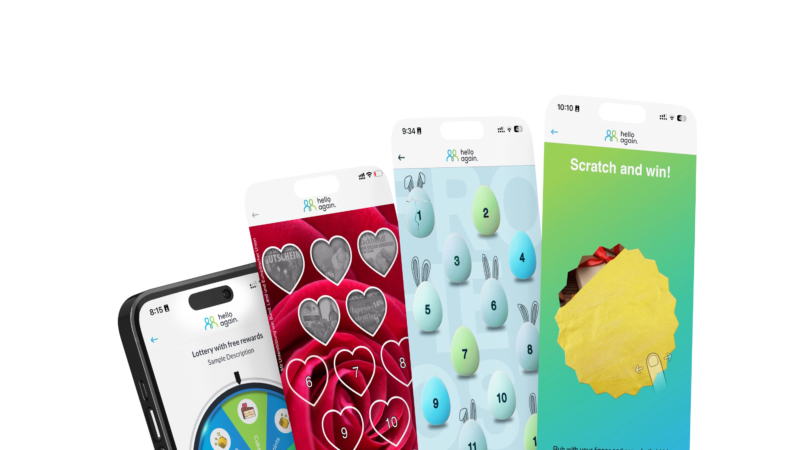
Combine points, loyalty cards, and personalized promotions and rewards all in one place within your own app—without the need for expensive in-house development.
Wallet card instead of a separate app
No app development required: Wallet passes for Apple and Google are often all you need.
| Situation | Compatible mechanism | Common Mistake |
|---|---|---|
| High purchase frequency, small shopping baskets | Stamp Card or Challenge | The reward is too far away |
| Low frequency, high average order value (e.g., consulting) | Benefits or Status | Discounts are eating into the margin |
| Many products, clear repeat purchases | Points + Personal Rewards | Rules that are too complicated |
| Many new customers, little data | Simple Onboarding + 1 Key Benefit | Get started right away with 20 features |
| Seasonal Business | Challenges + Recovery | Communication Only During the Off-Season |
Step 4: Plan the Customer Journey and Touchpoints
Customer loyalty isn't a single mailing, but a series of interactions over time.
- Onboarding: „Here’s How It Works“ + First “Aha!” Moment
- Activation: repeated use, not just signing in
- Repeat Purchases: Appropriate Occasions, Reminders, Recommendations
- Recovery: getting someone back before they're completely gone
Quick Check: Where do you lose the most customers today—after their first purchase, after two months, or after three visits? That’s exactly where you should focus your greatest effort.
Step 5: Communication & Engagement
Effective customer retention makes your customers feel like they’re receiving genuine support and after-sales service—not just advertising. That’s why you should focus on personalized content rather than mass newsletters.
- In connection with: Someone makes a purchase, signs up, or redeems a benefit
- Time-related: Someone has been inactive for 7, 30, or 60 days
- Value-based: Someone has reached VIP status or is about to earn the next reward
| Week | Promotion |
|---|---|
| 1 | Welcome them and explain how the benefits work |
| 2 | Send a personalized recommendation that aligns with their previous interests |
| 3 | Give them a little incentive to stop by again |
| 4 | Ask for their opinion and follow up with a small token of appreciation |
Gameplay elements should always motivate players to engage in a real storyline—not just serve as entertainment.
Step 6: Measure & Learn
Avoid data chaos. Focus on a few, easy-to-understand metrics.
- Repurchase rate: How many customers make another purchase within, say, 6 months?
- Redemption rate: How many coupons or perks are actually used?
- Per-capita revenue: On average, how much does a customer spend with you over time?
- Active users: Who has actually interacted with us or made a purchase in the last 30 days?
- Recommendation (NPS): How likely is it that someone would recommend you to others?
- No specific time frame has been set for the second purchase
- Redemptions were celebrated, but discount costs were not offset
- Email opens mistaken for actual purchases
Step 7: Pilot & Launch (with Checklist)
The safest path to launch: pilot → learn → scale.
- Is the benefit understood in 10 seconds?
- Will the first activation take place (e.g., registration + first redemption)?
- Which segments are reacting – and which aren’t?
Launch Checklist
Strategy
- Goals + Limits Defined
- Segment logic is in place (at least 4 groups)
Program
- Game Mechanics + Rules, Simply Documented
- Rewards are within reach
- Support FAQs Prepared for Customers
Communication
- Onboarding series is ready (3–5 messages)
- Triggers for "Active," "At Risk," and "VIP" Defined
- Sound is helpful, not intrusive
Measurement
- KPI definitions documented
- A fixed reporting schedule has been established
Go-Live
- Pilot program evaluated and adjusted
- Launch Date & Responsibilities Have Been Determined
- The plan for Weeks 1–4 after the launch is in place
Loyalty Apps as a Tool for Implementation
Having your own loyalty app makes many of the tasks described above much easier. Instead of managing points, segments, and trigger emails across multiple tools, they’re all centralized in one place. Providers such as hello again They offer ready-made building blocks for this: a digital wallet card instead of a paper stamp card, automatic segmentation based on purchasing behavior, and personalized promotions that are delivered without any manual effort. To get started, you can even build your own test app with no obligation to try out the mechanics in advance.
Conclusion: The Next Logical Step
When you take a systematic approach to customer loyalty, your success becomes predictable. This way, you can build a solid foundation, step by step, for loyal customers and increased revenue.
Frequently Asked Questions About Customer Loyalty Strategies
How long does it take to set up a customer loyalty strategy?
A first testable version can usually be built in 2 to 6 weeks if you focus on clear goals, a small number of segments, and simple mechanics. You can then fine-tune it on an ongoing basis during operation, based on real-world feedback.
Do I absolutely need a loyalty program?
No, customer loyalty can also be built through good service or a strong community. A program is especially worthwhile if you want to specifically influence behavior and clearly measure success.
What's better: points, discounts, or status?
That depends on purchase frequency, profit margin, and target audience. Points encourage frequent repeat purchases, while status is better suited to high-priced offerings. The overview in Step 3 shows you what works best for your situation.
Which KPIs are really important?
Repurchase rate, redemption rate, and a value-based KPI such as customer lifetime value are more than enough to get started—the only important thing is that time periods and segments are clearly defined.
What role do data and privacy play?
One key point: Customers should always understand the benefits they gain from their data. A streamlined, legally sound start is more important than collecting as much data as possible.
Why do many programs fail?
Most often, this is due to rules that are too complicated, rewards that take too long to earn, or a lack of regular communication. A simple system that your team can follow consistently is more important than a lot of features.
Do I absolutely need my own app for a customer loyalty strategy?
No. Wallet cards or a loyalty app like hello again are usually sufficient—a complex in-house development is rarely necessary.