


Anyone looking into digital customer retention today is quickly confronted with a jungle of acronyms, promises, and pricing models. Progressive Web App (PWA), white-label, mobile wallet—it sounds complicated, but it isn’t. At its core, it all comes down to this question: Which tool brings your customers back more often? And ideally, without straining your budget or your nerves.
But here’s what we can tell you right off the bat: Unfortunately, there isn’t one answer that fits everyone. What works for a bakery chain with 20 locations might be far too much for a single shop with a permanent staff. In this article, we’ll therefore take a look at a comparison of the six most relevant loyalty solutions —along with their respective pros and cons.
1. White-label app: The sweet spot for most businesses
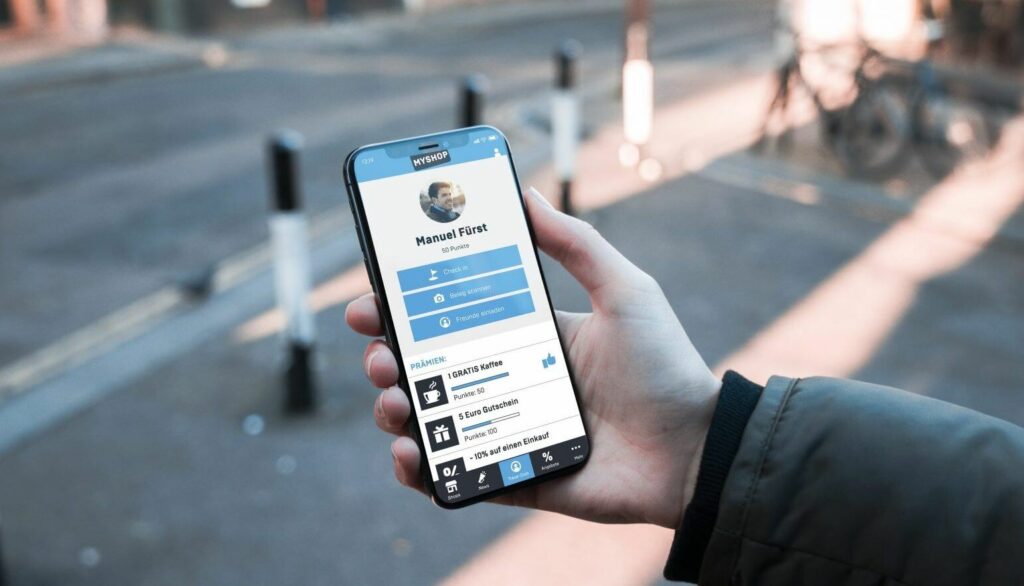
A white-label app is an existing, customizable solution that you can brand with your company’s design and start using right away—much like a modular system. You don’t need your own development team, and the app doesn’t have to be built from scratch. You get a well-designed, tested system that looks completely like your own app.
The biggest advantage is that you save not only money but, above all, time. While developing a solution in-house can take months or even years, with a white-label solution you can go live within a few weeks. On top of that, you get push notifications sent directly to your phone, detailed customer analytics and a provider who is constantly expanding the range of services and handling all technical details behind the scenes. This ensures that the app consistently meets current standards.
The expertise that goes into such platforms would simply be unaffordable if you were to develop them in-house. So what’s the catch? You’re dependent on the provider’s development efforts. If you need maximum control over every single feature, you’ll run into limitations here. And, of course, downloading the app presents a barrier to entry.
According to the DACH Loyalty Report 2026, however, 73.8 % of users who still use a physical card would immediately switch to a digital solution. So the interest is definitely there.
Suitable for: restaurants, bakeries, retail, and anyone who wants to get up and running quickly and professionally—even without an IT department.
2. In-House Development: When Flexibility Is Really Everything
The app , developed entirely in-house , is the ideal solution for anyone who refuses to compromise. You determine every feature, every data structure, and every user experience.
However, the cost should not be underestimated: Development costs in the five- to six-figure range are not uncommon. The time to market often takes a year or longer, and on top of that come the ongoing costs for maintenance, bug fixes, OS updates, and security patches. For corporations with their own tech teams, this is a viable approach. For everyone else, it’s usually an expensive lesson.
Suitable for: Large chains with their own development teams and a long-term technology strategy.
3. Progressive Web App (PWA): No download, but no push notifications either
A PWA (Progressive Web App) runs in the browser and feels like an app, without requiring anything to be downloaded from the App Store. This lowers the barrier to entry, which sounds good in theory.
In reality, however, there are some limitations—especially when compared to native apps, i.e., apps installed directly from the App Store. The difference can be summarized as follows:
| Website | Web App (PWA) | Native App | |
|---|---|---|---|
| Installation required | ✗ | ✗ | ✓ |
| Icon on the Home Screen | ✗ | ✓ (limited) | ✓ |
| Can be used offline | ✗ | in part | ✓ |
| Push notifications | ✗ | Limited (especially on iOS) | ✓ (User decides) |
Push notifications are short messages that pop up directly on a smartphone, even when the app isn’t currently open. They’re one of the most effective ways to regularly bring customers back. With native apps, users can decide for themselves whether to allow them. For web apps, especially on iPhones, they are still technically limited but possible starting with iOS 16.4.
On top of that: While it is now theoretically possible to add a PWA to the home screen, in practice significantly fewer users do so than with native apps. This means that the psychological anchor in everyday life is often missing.
Suitable for: Businesses with a very limited budget that want to take their first step into the digital world and are looking for a way to get started. A web app is often not a practical long-term solution.
4. Mobile Wallet (Apple Wallet/Google Wallet): Easy to add, easy to forget
Digital loyalty cards in the Wallet are cleverly designed: No app or password is required, and the card can be saved with a single tap on your phone. This works well for the first digital touchpoint.
What many people don't know: Behind the scenes, most wallet solutions use software that gives businesses insight into their program. For example, a dashboard allows them to view the total number of registered members, track card activations, and analyze the program's performance over various time periods.
Many wallet providers also offer push notifications directly to the lock screen, for example, when a customer receives a new stamp or is about to earn a reward.
Nevertheless, there are clear limitations compared to a full-fledged loyalty app: The personalization options are limited, complex customer journeys cannot be mapped, and deep CRM integration is truly mature only with a few providers. Anyone looking to move beyond basic analytics and simple stamp logic will sooner or later hit these limits.
Suitable for: Businesses that want to take their first step into the digital world without a large infrastructure. As a scalable, long-term solution with a genuine focus on customer loyalty, the mobile wallet is usually not sufficient.
5. Email Marketing & CRM: The Classic with a Stamina Problem
Email marketing isn't dead, but anyone who uses it as their primary customer retention tool is confusing a communication channel with a loyalty system. This is a common misconception—even in 2026.
There’s no score, no reward, and no visible feedback for customers. On top of that, there’s the structural problem: Inboxes are full, open rates are dropping, and messages aren’t reaching customers in real time. A push notification with the daily menu at 10:30 a.m. works. An email with the same content usually arrives too late—if it gets opened at all.
Emails are useful as a supplement: for newsletters, longer content, seasonal campaigns, or transactional emails. However, by 2026, they will no longer be sufficient as a standalone solution for active customer engagement. Modern customer retention solutions such as loyalty apps often even include a built-in newsletter/email marketing feature, so you have everything in one place.
Suitable for: Businesses that use email as a supplementary channel, but not as a substitute for a true loyalty system.
6. Messaging apps (e.g., WhatsApp Business): High visibility, high cost
WhatsApp has an open rate that email marketers can only dream of. People who receive a WhatsApp message usually read it. This makes messaging apps very attractive for targeted communication.
The problem: Every message costs money—and that’s per recipient. With growing customer lists, the costs add up quickly. Added to this are strict opt-in requirements, Meta’s template guidelines, and only limited options for implementing genuine customer loyalty mechanisms (point collection, gamification, etc.). As a direct communication channel for special occasions, this option is therefore well-suited, but it’s not really a suitable replacement for a full-fledged loyalty system.
Suitable for: Businesses that want to target specific, highly relevant messages and use this as a supplement to other systems, but not for their primary communication.
7. Comparing Loyalty Solutions: An Overview of the Tools
Before you make a decision, it's worth taking a look at all six solutions side by side—this way, you can see how they differ in terms of cost, feature set, and ease of use.
| Solution | Push Notifications | Analysis & CRM | Costs | Barrier to entry | Strengths | Fits |
|---|---|---|---|---|---|---|
| White-Label App | Yes | Yes | Medium | App download required | Quick start, proven technology, predictable costs, no development team required | Restaurants, Bakeries, Retail – Without an IT Department |
| In-House App Development | Yes | Yes | Very high | App download required | Maximum control over every function and data structure | Large chains with their own tech teams and long-term strategies |
| Progressive Web App (PWA) | Limited (iOS) | Limited | Low | No download required | No App Store, low barrier to entry | Very limited budget; a temporary solution, not a long-term one |
| Mobile Wallet | Restricted (Location Trigger) | No | Very low | No download required | No password, fast digital touchpoint | Very small businesses; simple digital time card |
| Email Marketing / CRM | No | Limited | Low | No download required | Great for newsletters, seasonal campaigns, and longer-form content | Supplementary channel – not suitable as a standalone solution |
| Messaging app (e.g., WhatsApp) | Yes (very high open rate) | No | High (per recipient) | No download required, or only WhatsApp | Maximum visibility, ideal for targeted individual messages | Supplementary channel for special occasions—not a loyalty program |
The Bottom Line: How to Find the Right Solution for Your Business
The white-label app hits the sweet spot for most businesses: a quick launch, proven technology, and predictable costs. If you want to turn walk-in customers into loyal regulars, you need a system that thinks for itself and appears on their phones right when they’re making a purchase decision.
Want to know exactly what works in your industry? In the free DACH Loyalty Report 2026, we surveyed 2,040 consumers about their expectations—with statistics that show you where the biggest opportunities lie.
If you take customer loyalty seriously—and you should, because according to the DACH Loyalty Report 2026 , users of loyalty programs spend an average of 27.9 % more and are even willing to go out of their way— then you’ll find it hard to do without a professional, native solution featuring real push notifications, personalization, and analytics capabilities.
FAQ: Frequently Asked Questions About Loyalty Solutions: A Comparison
What is a white-label customer loyalty app?
A white-label app is a ready-made, pre-developed solution that you can customize with your company’s design and logo. This means you don’t have to have an app programmed from scratch; instead, you use a tested system as a foundation. This saves time and money because a provider handles the technical development behind the scenes. For most businesses without their own IT department, this is the fastest way to get a professional app.
Is in-house development worth it for small and medium-sized businesses?
In most cases, no. An app developed entirely in-house often costs a five- or six-figure sum and takes a year or longer to launch. On top of that, there are ongoing costs for maintenance, bug fixes, and security updates. For corporations with their own tech teams, this can be worthwhile; for most other businesses, a white-label solution is the more cost-effective choice.
Is a PWA enough for a loyalty program?
A Progressive Web App (PWA) is a good first step in the digital journey because it doesn't require users to download an app. However, it has its limitations for a long-term loyalty program: Push notifications work only to a limited extent—especially on iPhones—and significantly fewer users add a PWA to their home screen than a native app. Therefore, a PWA is generally not recommended as a long-term loyalty solution.
What is the difference between a mobile wallet and a loyalty app?
A digital loyalty card in the Wallet can be saved with a single tap—no app or password required—and provides initial analytics, such as the number of members or card activations, via a dashboard. A full-featured loyalty app, on the other hand, offers significantly more personalization, more complex customer journeys, and deeper CRM integration. Wallet solutions are therefore well-suited as a simple starting point, but less so as a scalable, long-term system.
Can email marketing replace a loyalty program?
No. Email marketing is an important communication channel, but it is not a loyalty system. It lacks a visible point total, rewards, and real-time communication; moreover, open rates are steadily declining as inboxes become increasingly full. Email makes sense as a supplement to newsletters or seasonal campaigns, but not as a standalone customer loyalty solution.
Which loyalty solution is right for my business?
That depends heavily on budget, business size, and IT resources. For most restaurants, bakeries, and retail businesses without their own IT department, a white-label app offers the best balance of speed, cost, and feature set. Large chains with their own development teams, on the other hand, can benefit from in-house development, while PWAs, mobile wallets, email, and WhatsApp tend to serve as supplements or entry-level solutions.