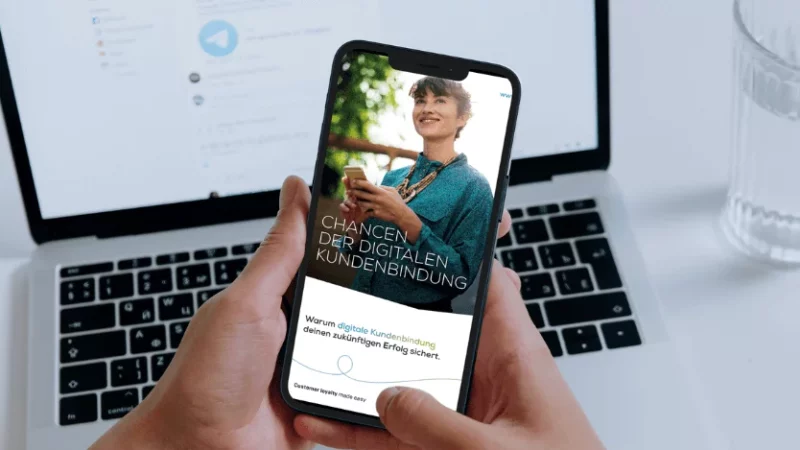


How many loyalty cards do you have in your wallet? And how many of them have you actually used recently? Most people know the answer: too many, and not often enough. That’s exactly the problem with plastic cards. They’re printed, paid for, and handed out—and then forgotten.
Nevertheless, many companies continue to cling to this approach and, as a result, miss out on the benefits of a digital customer loyalty program. After all, a digital loyalty card is right where your customers look every day anyway: on their smartphones. This turns a forgotten piece of plastic into an active channel to your target audience.
What makes the digital loyalty card so special? We've put together a clear summary of its key benefits for you.
Usability: Digital solutions are always with you
Since the smartphone has now become the most widely used medium and is increasingly replacing the wallet thanks to various mobile payment methods, loyalty cards should also make the switch to the smartphone.
Digital customer loyalty programs are implemented through a mobile app and are therefore impossible to forget. People of all ages now own mobile devices—the vast majority of the population in Europe already uses a smartphone today.
And since most cell phone owners carry their devices with them at all times anyway, this involves no extra effort for them. This way, customers always have their loyalty card with them and can enjoy the benefits of promotions, coupons, and other offers while shopping—all without having to use plastic cards.
Relevance: Personalized incentives for customers
Incentives such as discounts or rewards motivate customers to build loyalty. But incentives aren’t just created through point-earning programs; they’re also created in a playful way—known as gamification—which is easy to implement using digital solutions.
Thanks to these benefits, they’ll keep coming back to shop with you and even recommend you to others. „Buy ten coffees and get the eleventh free“—that’s the best example of this kind of incentive. With the digital loyalty card, customers no longer have to show plastic cards at the point of sale, but can simply use your own loyalty app, for example , simply scan the receipt.
Usability: Quick and easy registration
The digital approach also simplifies the registration process and the management of an entire customer loyalty program. In addition, our DACH Loyalty Report 2026 shows that customers want a simple and quick sign-up process.
With the digital loyalty card, there’s no more waiting. Customers can get started right away and take full advantage of all the loyalty program’s features. You can even sign up for the loyalty program using your existing Facebook or Google accounts to make the process even easier.
This automatically creates a link between the customer's account and their social media profile. Alternatively, prospective customers can register via email or text message. Since the entire process is automated , you—as a business owner—will save a lot of time, which will ultimately have a positive impact on your bottom line.
Communication: Personal, direct, and straightforward
The most effective customer loyalty programs are those that build a personal connection with their customers through continuous and direct communication.
Thanks to advanced technology and a spirit of innovation, there are simply so many different possibilities. For example, you can send personalized offers or reminders via email, newsletters, and push notifications or via beacon technology directly to your customers.
Loyalty Cards Go Digital: Consider the sustainability aspect
Thanks to this digital solution, physical plastic loyalty cards are no longer needed, nor are paper stamp cards or printed receipts at the register.
The production, packaging, and transportation of a physical customer card generate an average of about 150 grams of CO2 per card. This shows just how much a digital solution can help reduce CO2 emissions.
In addition, enables customers to use mobile payment options such as Apple Pay, making it easier for them to leave their wallets at home more often. This provides a flexible response to consumers’ new needs—digitally, quickly, and easily.
| Aspect | Plastic card | Digital Customer Card |
|---|---|---|
| Handling | can be forgotten | Always with you on your smartphone |
| Registration | On-site form | Seconds—even with social login |
| Communication | No direct address | Push, Email, Beacon |
| Sustainability | Approx. 150 g of CO2 per card | No physical production required |
| Market Research | very little data | detailed purchase and behavioral data |
Digital Loyalty Card: New Opportunities for Market Research
Generally speaking, loyalty programs serve, on the one hand, to retain customers and, on the other hand, to collect as much relevant customer data as possible in order to continuously optimize their offerings.
In the digital space, however, completely new possibilities open up: You can track purchasing behavior in detail and collect in-depth demographic data about your customers (of course, in compliance with data protection regulations).
This opens up entirely new possibilities for your market research. You can decide for yourself which information is relevant to you and which data you’d like to collect and analyze. Even surveys are easy to conduct—without needing a market research firm. This makes it easy to learn new things by sending out the survey digitally.
Retail and Beyond: Existing Customers Become Brand Ambassadors
The fine art of customer acquisition lies in turning existing customers into brand ambassadors. Market research consistently shows that consumers tend to trust the opinions of friends and family more than PR and advertising messages.
Numerous functions can be integrated into digital loyalty programs via apps or web solutions to motivate existing customers to recommend the program to their network.
For example, you can award loyalty points to participants when they share information or reviews on social media, or simply send an invitation to your loyalty program to friends and acquaintances.
Digital customer loyalty programs will be a clear competitive advantage for retailers in 2026. Especially in times of economic uncertainty, they help companies position themselves and stand out from the competition. Rewarding loyalty benefits both sides.
Rainer Will, Managing Director of the Austrian Trade Association
Conclusion: A win-win situation for everyone
Digital solutions are a true win-win—for you as a business owner and for your customers alike. Anyone who uses a digital loyalty card today combines ease of use, personalized communication, and valuable customer data all in a single system.
FAQ: Frequently Asked Questions About the Digital Loyalty Card
Why should a loyalty card be digitized?
A digital loyalty card is always at your fingertips on your smartphone, enables direct communication, and provides valuable data on purchasing behavior. Physical plastic cards do not offer these advantages and also incur ongoing printing and mailing costs.
How does the registration process work for a digital loyalty card?
Customers can sign up in seconds—either through existing accounts like Facebook or Google, by email, or via text message. This quick and easy sign-up process significantly lowers the barrier to entry compared to a paper form.
How does a digital loyalty card contribute to sustainability?
Since physical cards no longer need to be produced, packaged, and mailed, the associated CO2 emissions—averaging about 150 grams per card—are eliminated. This makes the digital solution a more environmentally friendly alternative.
What kind of data does a digital loyalty card provide for market research?
Digital systems collect data on shopping behavior and demographics, among other things—in full compliance with data protection regulations, of course. This information helps you tailor your offerings and conduct your own surveys without needing an external market research firm.
How do existing customers become brand ambassadors?
Digital loyalty programs can be equipped with features that encourage sharing and referrals—such as loyalty points for shared reviews or invitations to friends. Since personal recommendations often inspire more trust than advertising, this is a particularly effective strategy.