

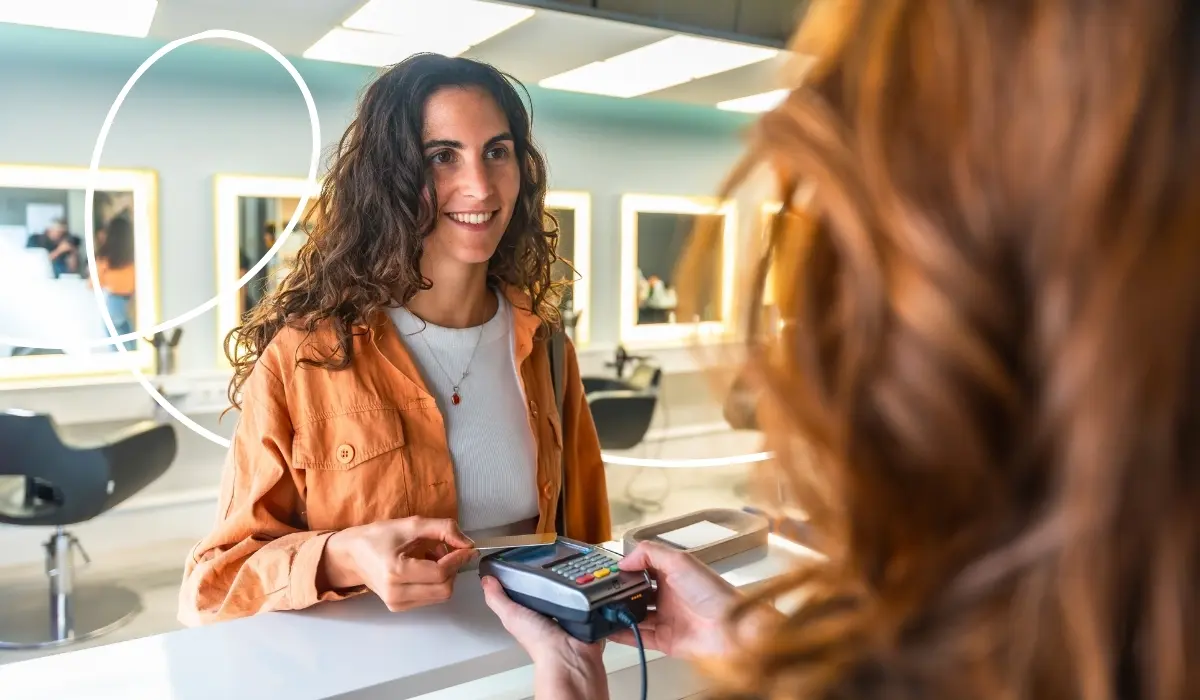
The moment at the register plays a key role in shaping how your loyalty program is perceived. If customers first have to dig through their wallets for a plastic card or recite their phone number while three people are waiting behind them, many will eventually just say, „Not today.” And eventually, they’ll lose interest altogether.
This is exactly where the NFC loyalty card comes in. Just hold the card briefly up to the reader—and you're done. There's no need to search for anything, type anything, or enter a query.
NFC stands for „Near Field Communication” and refers to a wireless standard for very short distances of just a few centimeters. You’re probably familiar with this technology from contactless payments using a card or smartphone. In the context of loyalty programs, it works on the same principle: A chip is recognized by the reader, the customer number is transmitted, and the points are credited.
For brick-and-mortar stores, this can significantly speed up the check-in process—from several seconds of searching to a single gesture. And the faster the check-in, the more often it takes place.
You don’t have to choose between a card and a smartphone. Modern loyalty apps use the same NFC standard, just without a physical card: Customers hold their phone up to the reader, their point balance is visible at any time, and you can also send push notifications. That’s why many businesses take a two-pronged approach: NFC cards for customers who don’t want an app, and an app for everyone else.
Which approach makes sense for you depends on your target audience and your point-of-sale system. In this article, we’ll show you how the technology works and when an NFC loyalty card is worth it.
What is NFC, and how does it work in the context of loyalty programs?
NFC stands for „Near Field Communication“ . This technology enables contactless data transfer between two devices. The range is a few centimeters, typically less than four.
You're probably familiar with this principle from contactless payments: hold your card or smartphone up to the terminal, wait a moment—and you're done. It is precisely this principle that can be applied to customer loyalty programs.
An NFC loyalty card contains a small chip. This chip stores a unique identifier that is comparable to a digital customer number. When you hold the card up to an NFC-enabled reader, the chip transmits this identifier. The system recognizes you and credits you with points or redeems a reward.
The key difference from a QR code is that you don't have to scan anything or open the camera. A quick tap is all it takes.
How is NFC different from RFID?
Technically speaking, NFC is a subcategory of RFID (Radio Frequency Identification, a method of radio-based identification). The main difference lies in the range. While some RFID systems operate over several meters, NFC is limited to a few centimeters. This makes NFC more secure for customer loyalty programs, as unintentional data reading is virtually impossible.
6 Use Cases: Where NFC Loyalty Cards Work in Practice
NFC technology can be used in a wide variety of situations. The following six examples illustrate where the technology makes the biggest difference in everyday loyalty programs.
1. Check-in and earning points at the point-of-sale system
The most common use case: You hold your NFC card up to a reader at the register; the system recognizes you, assigns your purchase, and automatically credits your loyalty points. This saves time and reduces errors. Fewer transactions are lost because the card is simply forgotten.
Particularly suitable for: Retail, grocery stores, bakeries.
2. Access to members-only areas or events
NFC cards can function as digital keys. A gym allows VIP members to access exclusive areas with a single tap. At events, the card serves as both an admission ticket and a loyalty ID.
Particularly suitable for: gyms, clubs, and event venues.
3. Automatic Time Card
Instead of collecting stamps or scanning codes, a simple tap using NFC automatically registers your visit. After a set number of visits, the reward is unlocked—all without any paper.
Particularly suitable for: cafes, bakeries, hair salons, beauty salons.
4. Interactive In-Store Experiences
NFC tags can also be attached to products, shelves, or displays. Just tap them with your smartphone to get additional information, exclusive offers, or bonus points. This combines the in-store experience with digital content—without requiring you to download an app.
Particularly well-suited for: Retailers of products requiring in-depth consultation, wine shops, and concept stores.
5. Quick identification for personalized offers
If the NFC system is connected to a CRM (Customer Relationship Management, the software for managing customer relationships), your team can identify the person with a single tap. At a glance, you can see: Which products do they buy frequently? When was their last visit? This allows for more personalized advice without having to ask a lot of questions.
Particularly suitable for: pharmacies, specialty retailers, and service providers requiring consultation.
6. Combination with Wallet Integration
NFC loyalty cards don't necessarily have to be physical. Many smartphones support NFC natively. This means that a digital loyalty card in Apple Wallet or Google Wallet also works with an NFC tap. This way, you combine the convenience of an app-free solution with the reach of digital wallets.
Particularly suitable for: Companies that do not require users to download an app but still want to work digitally.
NFC vs. QR Code vs. App: Which Technology Is Right for Your Business?
Choosing the right identification technology depends on your business model, your target audience, and your budget. A direct comparison highlights the key differences.
| Criterion | NFC card | QR Code | Loyalty App |
|---|---|---|---|
| Speed at the POS | Very fast (Tap) | Middle (Open camera, scan) | Medium (Open the app, show the code) |
| Do I need to download an app? | No | No (for static code) | Yes |
| Is hardware required? | NFC reader | Smartphone/Tablet Only | Smartphone/Tablet |
| Cost per card | Higher (1–3 € per card) | Very low (pressure) | No physical card |
| Features | Identification + Points | Identification + Points + Links | Full (Push, CRM, Gamification) |
| Personalization | Limited (via the backend) | Limited (via the backend) | Comprehensive, right in the app |
| target group | All age groups | All age groups | More tech-savvy |
| Is gamification possible? | Backend only | Backend only | Yes (Wheel of Fortune, Challenges) |
When NFC Is the Right Choice
- Your customers visit regularly, and the check-in process should be as quick as possible.
- Downloading an app can be a hurdle for your target audience, especially if they aren’t very familiar with smartphones.
- Your point-of-sale system supports NFC readers or can be easily upgraded to do so.
- You want a physical touchpoint that customers carry in their wallets.
When Another Solution Is a Better Fit
NFC isn't always the best option. If you need push notifications and gamification, a loyalty app is the better foundation because it offers more communication channels. If your budget is very limited, QR code-based solutions are more affordable to get started with because they don’t require NFC hardware. And if you want to reach customers outside the store, NFC alone won’t work. For that, you’ll need at least one digital channel.
Implementing an NFC Loyalty Card: 5 Steps to Implementation
The implementation follows a clear process. If you follow these five steps, you’ll avoid the most common pitfalls.
Step 1: Define the Goal
Before you invest in technology, determine what you want the NFC card to do. Is it to help customers earn points faster, reduce friction at the checkout, or serve as a physical anchor for your digital program? The goal will determine which systems need to be integrated.
Step 2: Review the POS system and infrastructure
Not every point-of-sale system supports NFC out of the box. Check whether your system supports NFC readers or if an external reader can be connected.
Step 3: Card Design and Ordering
NFC cards can be customized with your own branding, including colors, a logo, and a card number. Production costs typically range from 1 to 3 euros per card, depending on the print run and material. The unit price decreases significantly for larger print runs.
Step 4: Set up the backend and customer data
The NFC card is merely the physical touchpoint. Behind the scenes, there needs to be a system that links card numbers to customer profiles, manages points, and redeems rewards. Be sure to observe data protection regulations: Linking an NFC identifier to personal data requires consent that complies with the GDPR (General Data Protection Regulation, the European regulation governing the handling of personal data).
Step 5: Introduction and Communication
Even the best technology is of little use if no one knows about it. Actively promote the new NFC card: at the point of sale (POS) using display stands and by speaking with customers in person; online via your website and social media; and by offering an incentive—such as bonus points—upon initial registration. Your team should have tested the card themselves. A three-second explanation at the register often determines whether customers will use it long-term.
Decision Guide: Is NFC Right for Your Business?
Answer the following five questions to get an initial assessment.
| Question | Yes = Point for NFC | No = Check alternative |
|---|---|---|
| High frequency of visits (at least twice a month)? | Fast check-in pays off | A QR code or app is all you need |
| Is downloading the app more of a hurdle? | NFC lowers the barrier to entry | The app offers more features |
| Is the POS system NFC-enabled or can it be retrofitted? | Technically feasible | Investment in new hardware is necessary |
| Looking for a physical brand touchpoint? | Memorability and Branding | Digital-only is more cost-effective |
| Focus on the brick-and-mortar business? | NFC is designed for this | Apps and online channels are more important |
Result: If you answered “yes” to 4 or 5 questions, NFC is a good choice. If you answered “yes” to 2 or 3, a hybrid approach combining NFC and an app is worth considering. If you answered “yes” to 0 or 1, purely digital solutions are likely more practical.
Costs and Cost-Effectiveness: What You Should Plan For
One-time costs
- NFC cards: 1–3 € each, depending on the material, print run, and design. Unit costs drop significantly for orders of 500 or more.
- NFC readers: Simple USB readers are available starting at around €30–50. Integrated POS solutions may cost more.
- Design and Setup: Map design, backend configuration, and testing phase—included in the setup package, depending on the provider.
Ongoing Costs
- Reorder tickets for new customers or as replacements.
- Software License, if a separate loyalty platform is used.
- Maintenance, usually minimal, since NFC cards do not have batteries and last for several years.
When NFC Pays Off
The economic benefit stems primarily from the higher usage rate. If customers use their card every time they visit—rather than forgetting the code or failing to open the app—data quality improves. You’ll learn more about purchasing behavior and can tailor your offers more effectively.
According to the DACH Loyalty Report 2026, customers with an active loyalty program spend an average of 27.9 percent more. The higher your program’s usage rate, the stronger this effect becomes.
Common Mistakes with NFC Loyalty Cards and How to Avoid Them
- No trial period: Order NFC cards directly in large quantities without testing them in a live environment. Start by ordering 50–100 test cards.
- Forgot to integrate with the POS system: The card works, but the POS system cannot process the data. Check compatibility first.
- No added value communicated: Customers receive a card but don’t know why they should use it. Explain the benefit in one sentence.
- Data protection is underestimated: NFC data is considered personal information as soon as it is linked to a customer profile. Obtain consent and update your privacy policy.
- Relying solely on NFC: NFC works at the point of sale, but not on the way there. Combine the card with at least one digital channel, such as email or a digital wallet.
Conclusion
An NFC loyalty card triggers the decisive moment at the register: A single tap is all it takes, instead of having to search for and scan the card first. That may sound like a minor detail, but it determines how often your program is actually used.
This makes sense if your customers visit your store regularly, downloading an app is a hurdle, and your point-of-sale system supports NFC. To stay in touch with customers between visits, you’ll also need a loyalty app —this combination is often the best solution.
Frequently Asked Questions About the NFC Loyalty Card
What is an NFC loyalty card?
An NFC loyalty card is a physical card with an embedded NFC chip. When you hold it up to an NFC-enabled reader or smartphone, the chip transmits a unique identifier. The system recognizes you as a customer and can automatically credit points, record your visit, or trigger a reward. Unlike with a QR code, there’s no need to scan anything or open the camera—a quick tap is all it takes.
Do I need special hardware for NFC loyalty cards?
Yes, you’ll need an NFC reader at the POS. Many modern point-of-sale systems already have NFC built in—check with your provider. If not, external USB or Bluetooth readers are available starting at around 30 euros. No special hardware is required on the customer’s end: The card works passively and requires neither a battery nor a smartphone.
How do NFC loyalty cards differ from QR codes?
The most important difference is how they are used. NFC works with a tap, while QR codes require scanning with a camera. NFC is usually faster and less prone to errors, but it requires a reader. QR codes are more affordable to get started with because no reader is needed—a smartphone with a camera is all you need.
How much does an NFC loyalty card cost?
Production costs range from 1 to 3 euros per card, depending on the print run and materials. For larger orders of 500 or more, the unit price drops significantly. In addition, there are one-time costs for NFC readers starting at about 30 euros, as well as the setup of the backend software. Ongoing costs are primarily incurred through reorders and software licenses.
Is NFC secure? What about privacy?
NFC transmits data only over a distance of a few centimeters; reading it from a distance is practically impossible. This makes the technology more secure than, for example, Bluetooth or RFID, which have a longer range. Important: As soon as you link the NFC identifier to personal data, the GDPR applies. You need valid consent and must transparently describe what data you collect and for what purpose.
Does NFC work even without an app?
Yes, and that’s one of the biggest advantages. The NFC card works purely on a physical level: You hold it up to the reader, and the system registers the transaction. No app download, no login, no password. For users who avoid apps or want to save storage space, this is a clear advantage.
For which industries is NFC particularly well-suited?
NFC loyalty cards are particularly well-suited for brick-and-mortar businesses with high foot traffic, such as bakeries, cafes, hair salons, retail stores, pharmacies, and gyms. Anywhere where speed at the point of sale matters and a physical brand touchpoint is desired. NFC is less relevant for purely digital business models.