
In addition to cash and ATM cards, most of us carry a stack of plastic cards—for the drugstore, the gas station, our coffee-to-go, or the gym. Hardly anyone gives a second thought to the ecological footprint of these little plastic cards when making a payment.
We took this as an opportunity to take a critical look at the stack of cards—and to show that there has long been an easier, smarter, and, above all, more sustainable alternative: the digital loyalty card.
Plastic Waste in Europe: Numbers That Make You Sit Up and Take Notice
We are still producing far too much plastic waste. According to estimates, over 100 million metric tons of plastic waste are already floating in our oceans, and another eight million metric tons are added every year. If this trend continues, calculations by the Ellen MacArthur Foundation indicate that by 2050 there will be more plastic than fish in the ocean (Source: Ellen MacArthur Foundation).
At the European level, too, the amount of packaging waste is enormous: In 2023, the EU generated an average of about 178 kilograms of packaging waste per capita. Germany was well above that average at around 215 kilograms, while Austria recorded the highest figure in the entire EU at 782 kilograms of municipal solid waste per capita (Source: Federal Statistical Office, EU Waste Statistics 2025).
At least there is some good news coming out of Germany. According to the joint annual press conference held by the Federal Environment Agency and the Central Packaging Register (ZSVR), the recycling rate for plastic packaging there rose from 42 percent in 2018 to 70 percent in 2024 —and is thus well above the EU minimum requirement of 63 percent (Source: Federal Environment Agency & ZSVR).
In the rest of the DACH region, there is still significant room for improvement. In Austria, only a quarter of plastic packaging was actually recycled in 2024—the EU Packaging Directive has required at least 50 percent since 2025 (Source: ARA Report 2024, Altstoff Recycling Austria). In Switzerland, only about 9 percent of the approximately 790,000 metric tons of annual plastic waste is recycled; the majority ends up in incinerators—a notable exception being PET beverage bottles, which have a recycling rate of over 80 percent (Source: Federal Office for the Environment (BAFU)).
Credit cards, gas cards, loyalty cards—do we really need so many cards?
Our wallets are getting thicker and thicker: prepaid cards, loyalty cards, gas cards, and collectible passes for the soccer stadium. Add to that a driver’s license, ID card, e-card, and so on. The result: Our wallets are packed with plastic. Is that really necessary?
R.I.P. Plastic Card: The Flood of Loyalty Cards in the DACH Region
A study by the Austrian Gallup Institute shows that 83 percent of Austrians own at least one loyalty card, and the majority (45 percent) even have two to five of them (Source: Gallup Austria). Wallets full of plastic cards are not a phenomenon unique to Austria, but one that is widespread across Europe.
Consequently, there is a strong demand for a digital alternative—across the entire DACH region: According to the latest hello again Loyalty Reports 2026, 72.7 percent of people in Germany, 73.7 percent in Austria, and as many as 76.1 percent in Switzerland would switch to a digital solution right away if their favorite store offered one.
At the EU level as well, plastic remains a major contributor to packaging waste: About one-fifth (19.8 percent) of all packaging waste in the EU consists of plastic, with a current recycling rate of 42.1 percent (Source: Eurostat). It is therefore essential to curb plastic consumption across Europe and to prioritize alternatives right from the production stage.
Digital Loyalty Cards Instead of Plastic: Switching Is This Easy
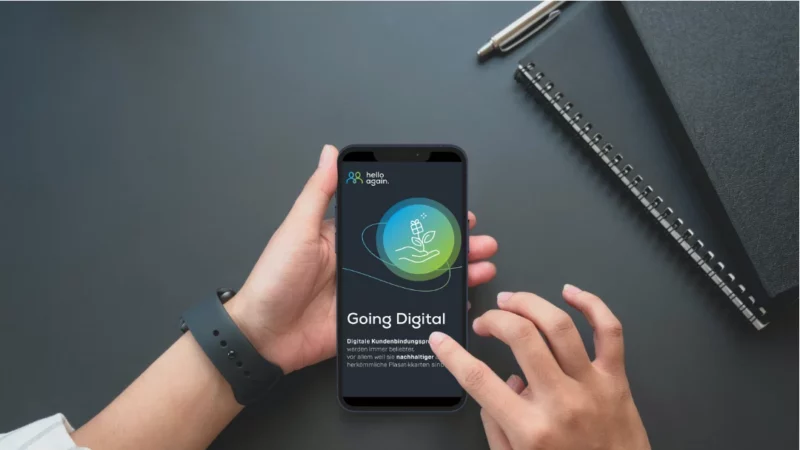
Does your company still rely on traditional plastic loyalty cards? Then it’s time to go digital. With the digital loyalty club from hello again, your customers will always have their digital loyalty card always at their fingertips—right on their smartphone, featuring your company’s custom design, and without any extra plastic.
Especially popular with customers: the digital stamp card, which replaces traditional paper or plastic collectible cards. Find out just how much your business stands to gain from switching to digital customer loyalty in just a few clicks with the free Loyalty Calculator.
Conclusion: It's Time for the Digital Transition
So there’s still an enormous amount of plastic in our everyday lives. The plastic card in your wallet is just one small—but striking—example. Companies that switch to digital loyalty cards now not only reduce plastic waste but also gain tangible benefits: higher revenue, loyal customers, and a loyalty program that truly fits in your pocket—or on your smartphone. In short: It’s worth joining forces to declare war on plastic waste.
FAQ: Frequently Asked Questions About Plastic Cards & Recycling
On average, how many loyalty cards do people in the DACH region have?
According to Gallup Austria, 83 percent of people in Austria have at least one loyalty card, and 45 percent have two to five. Similar patterns are evident in Germany and Switzerland.
Is a digital loyalty card really more sustainable than a plastic card?
Yes. A digital loyalty card reduces plastic waste, conserves production resources, and cuts down on transportation, since it is used directly on a smartphone and eliminates the need to produce a physical card.
What is the recycling rate for plastic packaging in Germany, Austria, and Switzerland?
In 2024, Germany achieved a recycling rate of 70 percent, Austria around 25 percent, and Switzerland about 9 percent of total plastic waste (excluding PET bottles, for which the recycling rate is over 80 percent).
How do I switch to a digital loyalty card?
With hello again's digital loyalty club, businesses can offer their customers a personalized digital loyalty card right on their smartphones—without any extra plastic. Schedule a no-obligation appointment now.